Enigma: What’s that in the Sky
- 3.5
- Rating
- 100.00K
- Installs
- Free
- Price

 Analysis by App-foxy
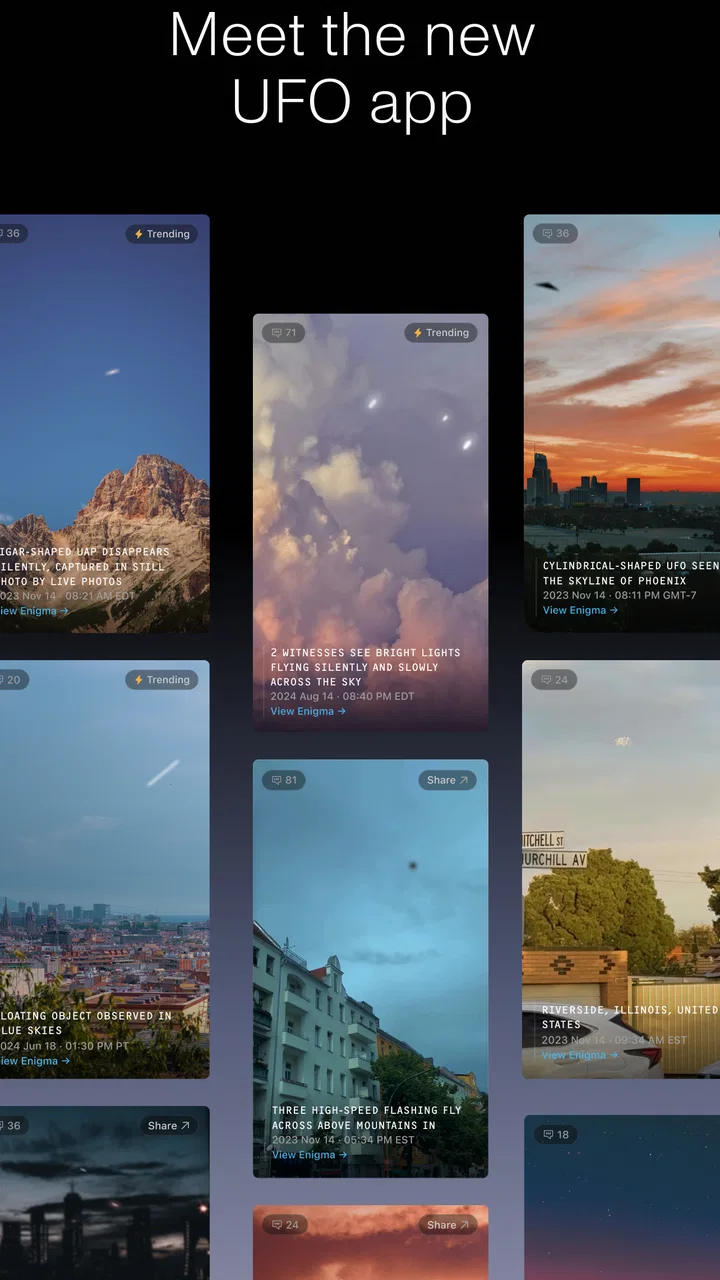
I opened Enigma: What’s that in the Sky expecting a quick way to record unusual objects overhead, and that is still the clearest way to understand it. This is a free news and magazines app from Enigma Labs, LLC, centered on reporting drone and UFO sightings. It is more interesting than a simple headline feed because it asks you to turn a vague observation into a documented report, but its lasting value depends heavily on whether you actually notice things worth recording.
My first impression was that the app has a strong curiosity factor. Seeing an unexplained light or an unfamiliar aircraft can make anyone want to check whether other people noticed the same thing. The app gives that moment somewhere to go instead of leaving it as a story told later to friends. That makes it appealing for skywatchers, aviation enthusiasts, local observers, and anyone who wants to keep a personal record of unusual sightings.
At the same time, I would not treat it as a replacement for a general news app, an aviation tracker, or a scientific identification tool. Its focus is narrower. The useful question is not whether it can entertain you for an evening, but whether reporting and reviewing sightings can become a habit you will still care about after the novelty wears off.
You May Also Like

 Blood Strike: 2.5 Anniversary
Blood Strike’s Loadouts Turn Every Drop Into a Tactical Gamble
A close look at Blood Strike’s custom loadouts: how fast access to signature weapons reshapes its battle royale rhythm, rewards preparation, and narrows the gap between fights.

 Pandora - Music & Podcasts
Pandora’s Music Is Easy to Start, but Harder to Recover
Pandora’s strength is its low-effort path from a seed to a station. Its weak spot is how much confidence it asks you to place in connection, setup, and quiet recovery.

 8 Ball Pool
 Is Built on Rivalries, Rematches, and Routine
A close look at the rivalries, rematches, shared routines, and unanswered safety questions that turn a quick pool match into a persistent mobile community.

 Samsung Music
’s Quiet Strength Is Playing What You Already Own
Its reach comes less from spectacle than from dependable access to a personal library. That simplicity is both the app’s strongest retention engine and its ceiling.

 AccuWeather: Weather Radar
AccuWeather Review: A Quick, Clear Forecast for Everyday Decisions
For everyday plans, the best forecast is the one you can understand quickly. AccuWeather makes rain timing, radar, and local conditions easy to act on, with a few trade-offs.

 Hill Climb Racing
Why Hill Climb Racing Still Turns Crashes Into One More Run
A tiny car, a bumpy hill and one more upgrade: Hill Climb Racing keeps resurfacing because its simple chaos makes every near-miss feel personal.
More From Our News Desk



From the first sighting to a repeatable habit
The app’s strongest first-week appeal comes from its immediacy. If something catches your attention in the sky, the best report is usually made while the details are fresh: where you were, what direction you were facing, how the object moved, how long you watched it, and whether anyone else was present. A dedicated reporting app makes that process feel more purposeful than typing a vague note into a general-purpose app.
I found the idea especially useful for separating observation from interpretation. A bright point may be a plane, satellite, drone, balloon, star, or something I simply failed to identify. Writing down what I actually saw before deciding what it means is a better habit than starting with a dramatic conclusion. That distinction is one of the app’s real strengths, because a report becomes more useful when it describes behavior rather than only attaching a mysterious label.
A practical routine is to prepare a short mental checklist before submitting anything. Record the approximate location, the time, weather as you experienced it, apparent color, sound, direction, speed, and whether the object changed shape or brightness. If you captured an image or video, keep the original file rather than relying only on a compressed copy. These steps make the app more valuable as a personal observation log, even when the sighting turns out to have an ordinary explanation.
That workflow also reveals an important limitation: the app cannot improve a report if the observation itself is weak. A shaky night video, an uncertain time, and a description based on memory will not suddenly become reliable because they were entered into a specialized service. I appreciate the app more when I use it as a structured notebook than when I expect it to solve every mystery for me.
The audience is fairly specific. If you enjoy looking for aircraft, following unusual sky events, or comparing your observations with reports from other people, the focused subject makes sense. If you only want breaking news, weather alerts, or verified explanations, a mainstream news application and a weather service will probably serve you better. Those alternatives are less exciting, but they are also more useful for everyday information.
The app is free, which lowers the barrier to trying it during a sighting without making a financial commitment. It is marked for Everyone 10+, so families may find the subject approachable, although younger users should still be encouraged to describe what they saw carefully rather than turn every unclear object into a sensational claim. The current version is 2.3.0, and I would keep the app updated because reporting tools are only worthwhile when they remain comfortable to use in the moment.
One subtle trade-off is the tension between speed and accuracy. A fast report preserves fresh memories, but a rushed report can omit the details that make it useful. A slower report may be more complete, yet waiting too long increases the chance of forgetting direction, duration, or movement. I recommend making a quick private note immediately, then completing the report once I am somewhere safe and can concentrate. That is more realistic than trying to type while walking, driving, or staring upward.
What remains useful after the excitement fades
After the first few sightings, the app’s value changes. The initial thrill comes from discovery, while the longer-term benefit comes from comparison. I can look back at what I personally observed, notice patterns in the kinds of events that attract my attention, and become more disciplined about recording evidence. That is a quieter benefit, but it is more durable than the surprise of opening the app for the first time.
For someone who already spends time outdoors, the reporting process can fit naturally into an existing routine. A person who walks in the evening, watches storms, photographs sunsets, or attends local events may occasionally encounter something worth recording. In that situation, the app does not need to be opened every day to justify its place on a phone. It can function as a specialist tool that is valuable precisely when the right moment arrives.
A realistic example would be an evening walk when I notice a silent light moving steadily across the sky. Instead of immediately calling it a UFO, I would note the time, stop somewhere safe, observe whether its brightness changes, check whether it follows a straight path, and ask a companion what they noticed independently. I could then submit a measured account. Even if the object later appears to have been a conventional aircraft or satellite, the record still teaches me what those movements look like in practice.
This is where the app can outperform a normal notes application. Notes are flexible, but they leave the user responsible for inventing a format and remembering where earlier observations are stored. A specialized reporting environment gives the subject a clearer purpose. The trade-off is that a notes app can hold anything, while this app is useful only for a narrow slice of experiences.
The wider community aspect may also support month-to-month interest, particularly when several people report something around the same time. A single observation is easy to dismiss or misremember; multiple independent observations can encourage more careful comparison. Still, I would avoid treating a cluster of reports as automatic proof of an extraordinary event. Similar weather, lighting, aircraft routes, social attention, and shared assumptions can all influence what people report.
That caution matters because the subject naturally attracts confirmation bias. Once I expect to see something unusual, ordinary objects can appear more significant. The best long-term use of the app is therefore not constant excitement but better observation. I would rather have a small number of precise reports than a large collection of dramatic descriptions that cannot be checked or understood later.
The public numbers suggest that the app has found a meaningful audience, with over one hundred thousand installs. Its average rating is 3.8 from around four hundred ratings, and there are around one hundred forty written reviews. I read that combination as a sign of genuine interest mixed with uneven satisfaction. People are likely drawn to the concept, but the narrow purpose means the experience will not match what every curious downloader expects.
The maintenance cost of keeping it worthwhile
The biggest maintenance burden is not technical; it is behavioral. To get lasting value, I need to remember to record observations consistently and avoid filling the app with incomplete guesses. That takes more effort than passively scrolling through headlines. If I only open it when I want entertainment, the novelty may disappear quickly. If I use it as an observation journal, it has a better chance of earning permanent space.
I would also maintain a simple personal standard for reports. Before submitting, I would check whether I know the approximate time, location, direction, duration, and visible behavior. I would separate what I directly saw from what I assume it was. I would avoid editing a memory to make it sound more dramatic. This small discipline improves the quality of my own record and prevents the app from becoming a collection of exaggerated impressions.
There is a safety issue that deserves plain attention. Looking upward can make people ignore traffic, uneven ground, bicycles, water, or other hazards. I would never report while driving, and I would move to a safe place before concentrating on the screen. The app is most useful when it supports observation rather than distracting from the surroundings. That may sound obvious, but the excitement of a sudden sighting makes basic caution easy to forget.
Another maintenance question is whether the app should stay installed between sightings. For frequent observers, the answer is probably yes because opening a familiar tool is faster than searching for one after an event. For occasional users, keeping it may feel unnecessary if months pass without a report. Since it is free, the decision is mainly about storage, attention, and whether the specialized purpose earns a spot beside more regularly used apps.
I also would not rely on it alone for emergency or practical information. If I see a possible aircraft problem, dangerous drone activity, fire, crash, or immediate public risk, the correct response is to contact the appropriate local service rather than assume a report inside a sightings app is enough. This app can document an observation, but documentation and response are not the same thing.
Its minimum operating requirement is Android 7.0 or later, which makes it accessible to many older Android phones. That is helpful for people who keep a spare device for outdoor use. Even so, the quality of the experience will depend on the phone’s camera, location handling, battery condition, and ability to function comfortably at night. Those practical factors matter more here than they would in a basic text-reading app.
Where repeated use can become tiring
The first source of fatigue is the gap between expectation and evidence. The phrase “UFO” can suggest answers, revelations, or constant strange activity, but most real observations are ambiguous. If I install the app expecting every report to lead to a satisfying explanation, I will probably become disappointed. The app is better suited to documenting uncertainty than eliminating it.
A second source is repetition. Once I understand the basic reporting idea, similar entries can begin to feel routine. The process remains useful only if I care about building a record, learning the sky, or comparing observations. Without one of those motivations, opening the app repeatedly may feel like work. This is why I see it as an occasional specialist tool rather than a daily news destination.
Community reports can create another kind of fatigue. More reports do not automatically mean better information. Some may be detailed, while others may be brief, emotional, or based on poor visibility. I would approach the material with the same skepticism I use on social media: look for specific observations, compare independent accounts, and resist conclusions that depend only on dramatic wording.
The narrow category can also make it less convenient than familiar alternatives. A general news app offers a broader stream of current events. A weather app helps explain visibility, cloud cover, and atmospheric conditions. An aviation-focused tool may be more appropriate when the main question is whether a visible object is a conventional aircraft. A camera app is better when the priority is capturing an image quickly. This app earns its place when the act of reporting and organizing a sighting matters more than any one of those individual tasks.
I would also skip it if I dislike making personal reports, prefer only professionally verified stories, or want a constant supply of new articles. The app’s premise asks for participation. It is not the right choice for someone who wants to remain a passive reader, and it may frustrate users who expect a definitive identification for every unusual object.
My long-term verdict for curious observers
After looking beyond the first-week novelty, I think the app has a legitimate but specialized role. It is most convincing as a structured place to record unusual sky observations, especially for people who already spend time outdoors and want to improve the quality of their notes. Its lasting value comes from repeatable observation, not from promising that every unclear light has an extraordinary explanation.
I would recommend trying it if you are genuinely interested in drones, UFO sightings, aviation observations, or keeping a careful record of what you see. Start with a modest goal: make one precise report when a real observation occurs, then review the entry later and ask whether it clearly separates facts from assumptions. That approach gives the app a fair test without forcing it into a daily habit it may not deserve.
I would not recommend it as a general news replacement, a safety reporting channel, or a guaranteed identification service. For those needs, broader or more specialized alternatives are more practical. The app’s focus is its identity, but that same focus limits its usefulness when your interests move away from unusual objects in the sky.
Enigma Labs, LLC has created something that can turn a fleeting moment into a more thoughtful record. Whether it stays installed depends on your behavior after the excitement passes. The real test is not how intriguing the first sighting feels, but whether the reporting habit continues to teach you something useful. For the right user, that is enough to justify a place on the phone; for everyone else, a short trial may be all it needs to provide.
FAQs for Enigma: What’s that in the Sky
01What is Enigma: What’s that in the Sky about?
Enigma: What’s that in the Sky is an interactive puzzle and exploration game where players identify celestial objects and phenomena. With a mix of educational content and engaging gameplay, it offers a unique experience for astronomy enthusiasts and casual players alike. The game combines stunning visuals with challenging puzzles to enhance your knowledge of the night sky.
02Is Enigma: What’s that in the Sky suitable for all age groups?
Yes, Enigma: What’s that in the Sky is designed to be family-friendly and suitable for all age groups. It offers varying levels of difficulty, making it accessible for younger players while still providing challenges for adults. The educational aspect makes it an excellent choice for children interested in learning more about astronomy.
03Does the game require an internet connection to play?
Enigma: What’s that in the Sky can be played offline, which is perfect for users who enjoy gaming on the go without relying on an internet connection. However, certain features, like updates or additional downloadable content, may require connectivity. Check the app settings for more information on offline capabilities.
04Are there any in-app purchases in Enigma: What’s that in the Sky?
Yes, Enigma: What’s that in the Sky includes optional in-app purchases. These can enhance gameplay by unlocking additional levels, content, or features. While the game is fully playable without purchases, these options offer players a chance to expand their experience with exclusive items or hints.
05What platforms is Enigma: What’s that in the Sky available on?
Enigma: What’s that in the Sky is available on both Android and iOS platforms. It can be downloaded from the Google Play Store for Android devices and the Apple App Store for iOS devices. Ensure your device meets the app’s system requirements for optimal performance and gameplay experience.
Pros
- Immersive graphics with stunning visuals.
- Smooth and intuitive user interface.
- Challenging puzzles that engage the mind.
- Regular updates with new levels.
- Offline mode available for on-the-go play.
Cons
- Limited free content before in-app purchases.
- Occasional lag on older devices.
- Ads can be intrusive to gameplay.
- Lack of multiplayer or co-op mode.
- Some puzzles may feel repetitive.

Enigma: What’s that in the Sky
Gallery